The Nonprofit Success Model

Updated: May 9
The primary sign of success in nonprofit programming is when someone from another community visits your site and says, "This is amazing! We need this program in our community." How exactly do you replicate a successful program to another organization, site, or branch of your organization in another community? Replication can be hard or easy -- it all depends on how you structure your organization to anticipate success from the earliest stages.
HERE IS THE TGG TECHNICAL BULLETIN ON THIS GROUND-BREAKING MODEL:
INTRODUCTION
The philosophy of NSM is that the ultimate sign of success for a nonprofit program is when it is stable, producing measurable results, and then people from other communities visit and want it to be replicated in their community. TGG uses these phrases to describe the proper sequence of the stages of the approach:
STAGES TO TRUE SUCCESS
Proof of Concept
↓
Pilot Program
↓
Working System
↓
Proven Program
↓
Systematic
↓
Sustainable
↓
Scalable
↓
Replicable
The common problem is that nonprofit decision-makers are not aware of the proper sequence of the phases required for success. As a result, they start with a small, passionate team (or alone) focused on the program and the clients, with little forethought about how to establish and grow it to maturity and success.
If they are successful in the short-term, then others of like mind will visit and ask for it to be replicated in their community. While wonderful, the fundamental problem is that there is no way for replication to happen easily. There are two paths available: 1) the people have to “live” with you for six months to learn the program by osmosis or, 2) you must refocus your energy on training them and helping them replicate it, which diverts energy away from running the program itself, leading to decline. Neither approach is recommended or practical. NSM is designed to solve these challenges.
PHASE 1: A STRONG ORGANIZATION
TGG firmly believes that for a good program to become a strong program, it must be supported by a strong organization first. Thus, building a strong organization is the foundation of future client and program success and a top priority for the nonprofit’s leadership.
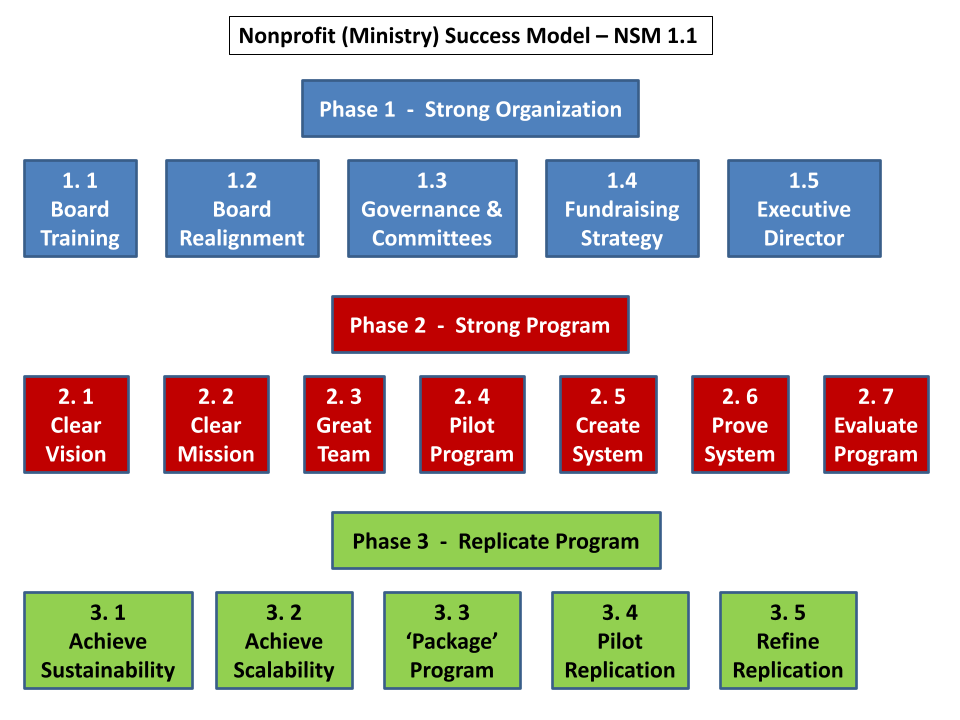
As can be seen from the diagram, tasks 1.1 through 1.3 are focused on the foundation of a strong organization: a strong Board of Directors. In over 40 years of nonprofit leadership experience, TGG has found that a committed, effective Board is the number one factor influencing the long-term success of the organization. Getting this right is not easy. It will take some time and skill but it will usually fix most if not all of the downstream issues that you may be facing or are going to face in the normal course of events.
1.1 Board Training: The existing Board members are taken through a short training session. Once they understand their roles, responsibilities, and fiduciary duties, they are asked to decide if they are still committed to being on the Board.
1.2 Board Realignment: Usually, this results in a realignment of the Board, which can include some members leaving and having to replace them with some new ones (who will also need to be trained).
1.3 Governance & Committees: Once a committed Board is in place, we review in-depth the governance of the organization (the center of which is the By-Laws) and the forming of the core Board committees (the Executive and the Finance committees). This may require a special meeting of the Board.
1.4 Fundraising Strategy: Fundraising is a core responsibility of the Board. (The top “lesson learned the hard way” in the past 40 years is that Board members who refuse to raise funds for the organization and its programs should not be on the Board.) Developing and implementing the functions, steps, and responsibilities for a successful strategy typically takes three to six months. For details on the TGG strategy, reference our position paper, The War Chest.
1.5 Executive Director: The final part of the Board’s function is to create the job description for the Executive Director, hire that person to carry out the mission of the organization, and give them the funding to do exactly that. The Executive Director should not be responsible for raising money -- that is the Board’s job. Mixing these up has led to the demise of many nonprofits.
PHASE 2: A STRONG PROGRAM
For a new or struggling program to become a strong one, worthy of replicating, seven stages required:
2.1 A Clear Vision: Begin with creating a clear vision statement for the program. For a detailed explanation, refer to the TGG position paper Creating Your Vision Statement.
2.2 A Clear Mission: Equally important is creating a clear mission statement for the program. For details on how to do this, refer to the TGG position paper Creating Your Program’s Mission Statement.
2.3 A Great Team: In brief, a program requires three basic roles, the Program Director, one or more Program Staff, and one or more Program Volunteers. The main point here is that a strong program is not dependent on one individual but on a well-designed team. A common problem is that the Founder of the organization becomes the Executive Director of the organization and also tries to function as the Program Director. This “might” be okay for the Pilot phase but even that is not recommended. Team-building should be wired into the design from the beginning to achieve long-term success.
2.4 A Pilot Program: In the pilot program stage, you are “building the airplane as you are going down the runway”. Typically, you are inventing something new (not implementing someone else’s existing program) and need the freedom to figure out things in a loose and informal way. This is an exciting and challenging time and it will require you to focus on the end result - some stable results (outcomes) that show great promise and confirm that you are on the right track. This is where you take it from an informal concept to a formal approach that deserves to be pursued and made “repeatable”.
2.5 Creating the System: In basic systems theory, a system has three primary parts -- the Input(s), the Process(es), and the Output(s). The goal of this phase is to take your program in its raw form, divide into these three parts, and mature each one until the program is repeatable; that is, can be run by someone other than the inventor and achieves the same results. The typical components of a mature system include policies, procedures, technology to support the procedures, training materials, and detailed instructions on how to operate the system or program. The challenge is to make the program as systematic as possible while still treating each client as a unique individual with dignity and respect.
2.6 Proving the System: This stage contains two separate parts, gathering data that will prove the effectiveness of the program (goals vs. outcomes) and continuous process improvement. For insight on data gathering, reference the TGG position paper Your Data-Driven Program. The continuous process improvement technique that TGG uses and recommends is the time-honored PDSA model. As shown in the diagram below, the four steps are to PLAN each process, DO the process, STUDY the results, and ADJUST the process, repeating this pattern as many times as needed to get standardized results.

NOTE: This is a very basic introduction to continuous process improvement. It is a process that can truly benefit any nonprofit to master it in the long run.
2.7 Evaluating the Program: Program evaluation is a staple of program maturity. The simplest path to a strong evaluation is to partner with a local university that has a school of social work (or other academic discipline close to the work you are doing). Ask for the head of the school to review a proposal for a program evaluation. Many times, they will assign a graduate student to perform the evaluation, which is done free of charge. This greatly benefits the student (and their school) by giving them hands-on experience in the real world. The school will typically provide the evaluation standards and the method.
NOTE: It is important to note that the term “evidence-based program” is tossed about very easily in the nonprofit world by people who have no understanding of the actual meaning of the term. By strict definition, for a program to be classified as evidence- based (the “gold seal” of program endorsement and approval), it must have been running consistently for 10 years, produce measurable results with academic rigor, and be evaluated by two separate, independent academic experts with the right credentials for the subject matter of the program. By this high standard, it is the opinion of TGG that 99% of all programs claiming to be evidence-based are not. Those that are in the process of pursuing this formal course of validation can be labeled “researched-based”. Those that are much earlier (younger) in the process are labeled “emerging practices” or “promising practices”.
PHASE 3: REPLICATE THE PROGRAM
The final phase of NSM is to establish and “package” the program so that it easily replicates at the new location and produces the desired results with the least amount of effort possible.
3.1 Achieve Sustainability: In the TGG method, a program can be fruitful and systematic but still not achieve sustainability. Our definition is that in addition to it being healthy, high- quality, and mature, it is self-funding. Prior to replication, It needs to evolve to the point that it no longer needs special funding, fundraising, or being grant-dependent. For more details, refer to the TGG position paper Nonprofit Programs that Self-Fund.
3.2 Achieve Scalability: The TGG definition of scalability is that the program can grow in capacity and impact simply by adding more funding which will provide more capacity (staff and space). This requires planning for the program to scale in the earliest stages of planning. The underlying structure that enables this is that program’s methodology is systematic and mature. Achieving scalability is also a prerequisite for replication.
3.3 ‘Package’ the Program: Create a complete set of all the information that the new site needs to be able to quickly implement the program in a standardized way. The key is to identify the core activities which define the unique “recipe” for the success you have achieved. Then surround your specific solution with all of the supporting material it takes for someone else to understand it, plan it, do it, and succeed with it.
NOTE: It is perfectly acceptable for you to charge a fee for this product. Done right, it can both bless the new site and generate valuable revenue for your nonprofit. You can also charge for consulting, running training courses, and other related activities.
3.4 Pilot the Replication: These last two steps are primarily performed by the team at the new site. Their first task is to assemble a small cohort of clients and run a pilot project. Their goal is to achieve a reasonable level of program success similar to the promised outcomes. Then they can use the PDSA model (see 2.6 above) to do their own internal evaluation. Or they can engage someone from your organization to assist them.
3.5 Refine the Replicated Program: The replication site will be most successful if they also implement the culture and practice of continuous process improvement (see 2.6 above). In some cases they will run it exactly as you have designed it to run. Others sites will have unique factors that steer them to adapt the program to their situation. If it is important for your organization to have your program run according to strict standards without adaptation, you should make this clear early in the process.


Comments